

Marketing in the age of AI: a new responsibility

The consultancy sector is now at the epicentre of technological disruption. Artificial Intelligence (AI) is not merely a trend, but a structural transformation across all areas. In this context, the traditional role of the consultant has evolved from the operational to the strategic, with a key emphasis on data analytics, systems integration and, above all, ethical governance.
The way we consume information is also changing so fast that consultancy is forced to rethink how it accompanies organisations in marketing and communication. To continue to deliver value, it needs to focus its services on approaches that strengthen reputation and build trust, two elements that make a difference in today's increasingly complex digital environment.
The role of leaders and consultants in this context goes far beyond adopting new tools. It requires understanding the entire artificial intelligence journey: defining a clear strategy, ensuring compliance with data protection rules and acting responsibly at every step. It also involves training teams to use these technologies judiciously, safely and practically.
Today's marketing teams are working under increasing pressure. According to the Adobe for Business’ AI and Digital Trends 2025 Report, it is expected to see a significant increase in both interactions and conversions (44% of respondents), while being asked to generate more personalised content (43%). A challenge that continues to escalate.
According to an Adobe report, increases in interactions and conversions are expected
To take on this volume, AI becomes a necessary support: it automates repetitive tasks, streamlines processes and helps make decisions with greater clarity, freeing up time to focus on higher-impact initiatives.
Even so, although 19.9% of Spanish companies claim to use AI systems, 60% still do so in an experimental or pilot phase, reflecting the way ahead.
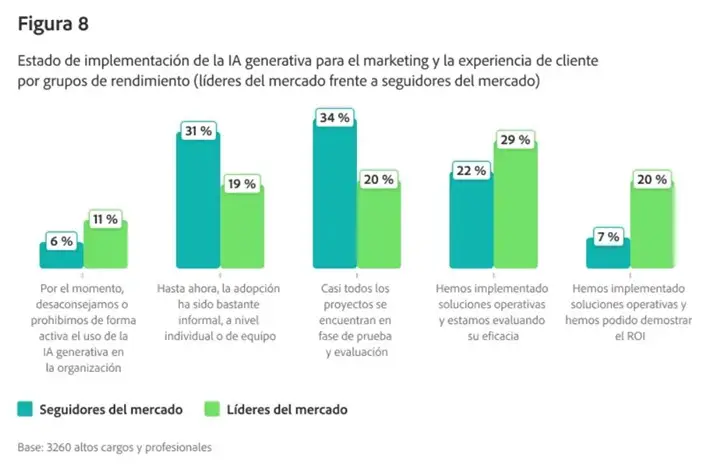
The biggest obstacle? The lack of qualified personnel, which affects 45.8% of companies according to the Bank of Spain (2025). Technology alone does not solve the challenge: it is necessary to build teams, define responsibilities and ensure that the new processes are integrated with the organisation.
The role of consultants moves towards the strategic and away from the operational, focused on interpreting metrics for early detection of problems and influencing high-risk decisions.
AI does not come to marketing as just another programme. It changes the way of working and pushes to create hybrid teams, where people with business vision, data specialists, creative profiles and those responsible for compliance and privacy coexist.
The challenge is not only technological, but also human
In fact, according to DigitalES (2025), outside the technology sector, marketing and communication account for around 38% of vacancies, a sign that transformation is not exclusive to technical areas.
According to data from LinkedIn Talent Blog, the position of 'AI Engineering' is among the fastest growing in the country.
Governance and ethics: the new centre of gravity
With AI, marketing enters particularly sensitive territory: it influences decisions and perceptions, works with data and operates in channels that affect reputation. Governance (rules, roles, records and auditing) therefore moves from being a compliance issue to become part of the strategic core.
European regulation reinforces this idea. The AI Act provides for penalties that, according to the text, can range from 7.5 to 35 million euros per violation, and requires classification of systems according to risk levels. In addition, the Spanish Data Protection Agency has announced surveillance of digital marketing for its potential for manipulation, adding pressure on segmentation, automation and personalisation practices.
In marketing and communication, human supervision is key to such concrete issues as:
- Identify who creates the content and when
- Ensure proper data processing
- Inform the user when interacting with chatbots or virtual assistants
The role of Izertis
Izertis has positioned itself in the Spanish market as a benchmark in strategic AI consultancy thanks to the monitoring of European regulatory frameworks (AI Act, NIS2, DORA, CRA, ISO 42001, ENS). In addition, in May 2025, Izertis obtained the ISO/IEC 42001 certification whose key is to ensure transparency, security and traceability: that operations and decisions are recorded, auditable and that there is a verifiable history of information assets.
"ISO 42001 positions us as a trusted partner that guarantees ethical, reliable AI solutions that are ready for the regulated future", says Miguel Ángel Acero, Director of Innovation and Consulting.
The achievement of ISO 42001 positions Izertis as a trusted partner
In short, AI is pushing marketing to a tipping point: it is not enough to speed up content production or automate tasks. The real impact is played out in trust.
As personalisation and automation grow, so do demands on data control, message consistency and transparency with the user.
In this context, the differential value is no longer 'doing more', but knowing what to do, why and with what guarantees. All under human supervision and clear criteria.
The debate is therefore no longer technological but organisational and reputational. The lack of specialised talent, the still uneven real-world landing and a more demanding regulatory environment mean that teams and processes need to be structured to take advantage of AI without losing governance over it.
In marketing, where every interaction affects brand perception, traceability and accountability are conditions for innovation without compromising credibility.
Article co-authored by Luisa Cáceres and Liseth Martínez.
Forthcoming publication: Hybrid marketing: how AI redefines the brand-user connection