
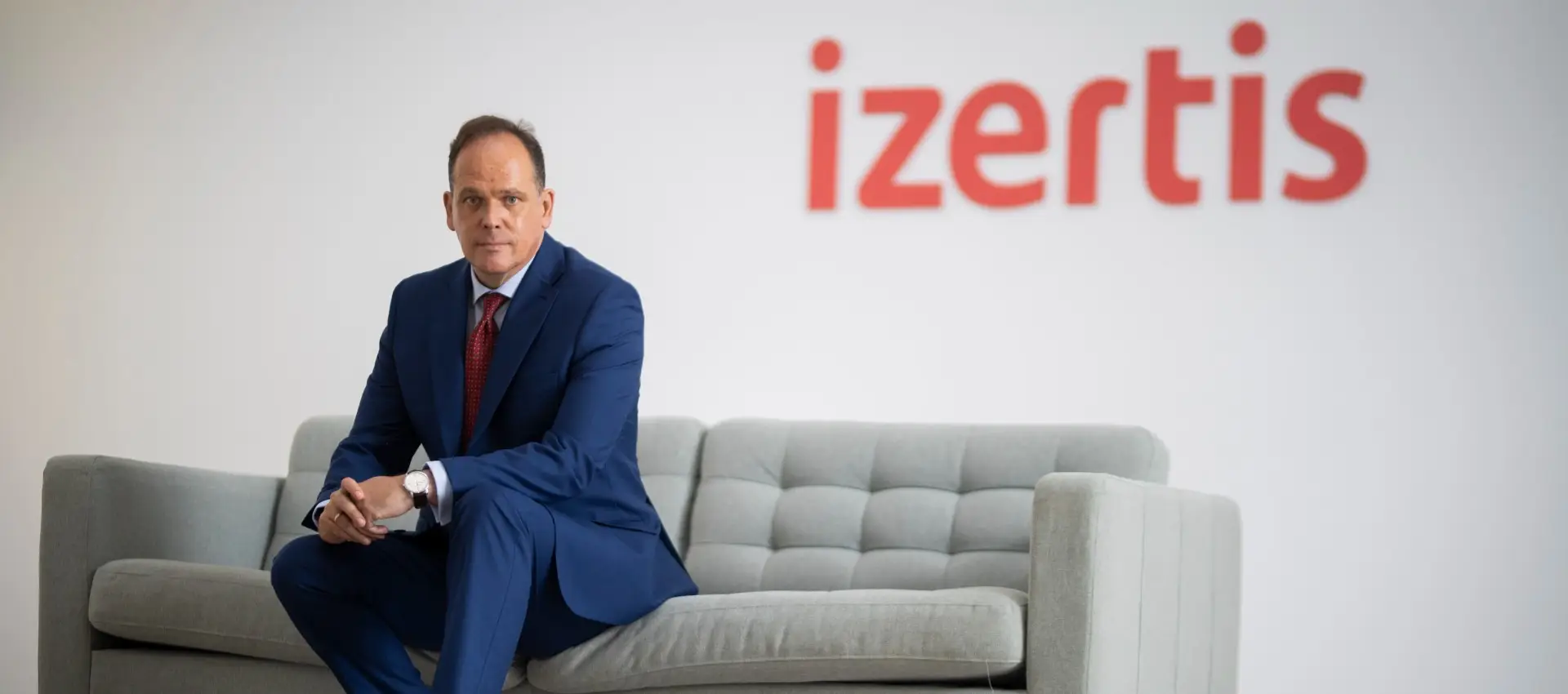
Thirty years on, Izertis’ journey has only just begun

“We have a clear strategic vision of where we want to go and what we want to do, and, moreover, we believe we will achieve it. We have no doubts, only uncertainty about how hard the road will be.” Pablo Martín said this in an interview in October 2014. Izertis had just acquired the Mexican company Cleven and was crossing the Atlantic for the first time. It was then a fraction of what it is today, and almost everything remained to be done, but its founder and chairman was already speaking of “a more innovative, more global company with the best team”. Twelve years later, that statement says more about the company than any set of financial results. The road was hard. The doubts, however, never weighed heavily.
Starting from the bottom
Izertis' story begins on 26 October 1996 in a mezzanine office on Calle Marqués de San Esteban in Gijón, Asturias. A 23-year-old, with no savings and more intuition than resources, opened an office to sell, install and repair computers for small businesses in his city. There was little furniture, all of it second-hand, and a blue fax machine that was meant to connect that office to a market that was only just beginning to emerge.
The early years were a crash course in learning. In 1998 came the first acquisition, ChipBip, and with it a way of growing that the company has never abandoned: since then, Izertis has integrated 47 companies. There were also a few setbacks. A chain of shops that was worth less than its numbers suggested, and the arrival of large retail chains, put the founder to the test. He would later remember that experience as “a genuine MBA”.
From that period came a rule that still holds: commitments are honoured, whatever it takes. On that habit, the trust of the financial sector was gradually built.
A never-ending metamorphosis
Izertis finds it hard to stand still. When the local market became too small, it went looking for others; if a client stopped growing, a new one appeared; and business lines that lost momentum gave way to different activities. Pablo Martín described it as “a complete and continuous process of metamorphosis”, and the technology consultancy made the phrase its own. In 2011 it changed its name, and shortly afterwards began expanding across Spain: first to the Basque Country and then to Madrid. In 2014 it went to Mexico, and Colombia, Peru and Portugal followed.
In 2008, the company had turnover of 3.8 million euros and around fifty employees. A decade later, it had more than 500 professionals and was already talking about the stock market.
The word given
On 25 November 2019, Izertis rang the bell at what was then the Alternative Stock Market (MAB). “This is not the end of anything. Not the end of a stage. It is the beginning of a great journey,” said its chairman. Minutes earlier, he had dared to tell the media something that may have sounded bold: within about five years, the company would move to the main market. In July 2025, it made the leap to the Continuous Market, almost exactly within the timeframe it had set itself.
In between came a pandemic, the European Commission’s Company of the Year award and inclusion in the Financial Times ranking of Europe’s fastest-growing companies, among many other accolades. There was also a decision that does not appear on any balance sheet: keeping its registered office in Gijón, despite recommendations to move it to Madrid.
What lies ahead
Izertis ended 2025 with revenue of 166.9 million euros. It operates from offices across Europe and the Americas, serving the banking, industrial, defence, aerospace, healthcare and public sector industries, and was the first Spanish technology consultancy to be certified to ISO 42001, the international standard for artificial intelligence management.
None of these figures is a destination. The 2030 Plan targets 500 million euros in revenue and 65 million euros in normalised EBITDA, which would triple the company’s 2025 turnover. To achieve this, the company aims for half of its business to come from outside Spain. It will continue acquiring companies to gain scale in a highly fragmented sector, and will strengthen its offering in artificial intelligence and cybersecurity, two fields where much of the coming decade will be decided
AI sits at the centre of that vision. Izertis does not see it as a threat, but as a productivity lever that will gradually enter organisations, at the pace allowed by their systems, culture and people. The multinational is convinced that technology will ultimately be within everyone’s reach, and that the winners will be those best able to integrate it. That is why the company prioritises training and attracting the talent this transformation requires.
It is the intuition of 1996 with different tools: seeing what is coming before it becomes visible, and arriving a little earlier than everyone else. Back then, the novelty was that a small business could connect to the internet. Today, it is that an entire organisation learns to work with (and unlock the potential of) artificial intelligence.
The blue fax machine stopped ringing long ago. The 2014 statement, however, still rings true. Izertis enters its fourth decade with a clear vision of where it wants to go and the conviction that it will get there. The uncertainties are the same as they were then: how hard the road will be. But on that day in 2019, on the Madrid stock exchange floor, Pablo Martín had already warned: none of it was an ending.
Thirty years on, the journey has only just begun.