
AI in software development: how to innovate without losing control
Artificial intelligence is already an integral part of software development. The challenge is not just to harness its ability to speed up tasks, but to integrate it without losing control over the code, the knowledge and the digital products. Rubén Díaz, Director of Cloud Applications at Izertis, discusses how the company is moving from AI-assisted development towards a more automated and agent-driven software lifecycle.
Artificial intelligence has been gaining ground in software development for years. The arrival of GitHub Copilot in 2021, before ChatGPT popularised generative AI among the general public, marked the beginning of a transformation that is now having a major impact on the work of technical teams.
The question is no longer whether developers will use these tools. In many cases, they already do. The question at hand is how to integrate them into an organisation’s processes, using which models and in accordance with what criteria regarding quality, security and compliance.
The risk of losing control
AI can reduce lead times, streamline iterations with the business and simplify numerous tasks. It can also help to improve the quality of the product, the documentation and its subsequent development. However, using it to develop software is not without its risks.
AI can reduce development times, speed up iterations with the business and simplify numerous tasks, but it does not guarantee zero risk in software development
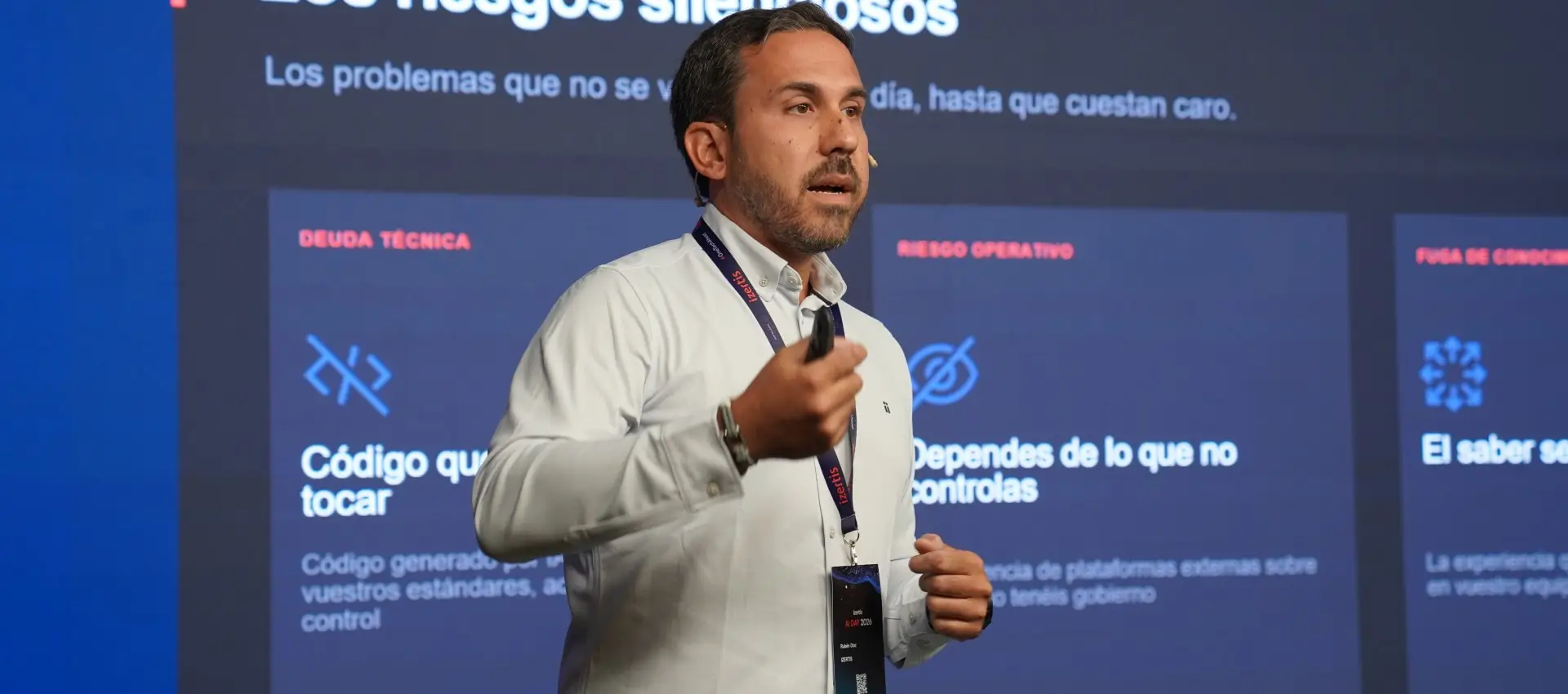
Rubén Díaz summarizes it all in a single sentence: the loss of control. “You’re delegating development to language models or artificial intelligence agents that are unfamiliar with your standards, your protocols, your quality policies and the regulations you have to comply with…”, he points out.
Added to this risk is the reliance on the tools used to generate and maintain the code, and what Díaz refers to as 'knowledge leakage'. “The more code that has been generated by AI without any specifications, oversight or documentation, the greater the chaos that ensues when you have to troubleshoot issues that arise in production,” he warns.
Without context, specifications or proper supervision, it is more difficult to understand technical decisions, correct errors or incorporate new features. The speed achieved during development can subsequently become a maintenance issue.
Regulating the use of AI
The answer is not to restrict these tools or to introduce controls that slow down the work. The aim is to facilitate their integration within an organised, safe and measurable environment. Izertis’s software and digital product development teams took on the challenge of “bringing order to all this chaos and managing it, with the focus on facilitating the adoption and correct use of artificial intelligence, rather than introducing red tape and complicating its use”.
The model is based on two main strands. The first aims to industrialise the use of AI through tools, models and corporate methodologies. The second focuses on governance, observability and learning. Both must also move forward in a technological environment subject to constant changes in suppliers, protocols, models and costs.
It is not simply a matter of making a code assistant available to developers. The key lies in integrating it with the organisation’s knowledge, its architectural criteria, its security policies and its quality requirements.
From the SDD to the agent lifecycle
On this basis, Izertis has rolled out its own framework and methodology. The starting point was Spec-Driven Development, known as SDD, a model in which specifications cease to play a secondary role and become one of the main assets of the digital product.
Code assistants must be familiar with the company’s knowledge base, its architectural criteria, its security policies and its quality requirements
Díaz explains that it is “a proprietary development framework that began under the name SDD, in which specifications become one of the main assets of the digital product, and which is now evolving into what is beginning to be called ‘agent-based SDLC’, that is, the agent-based software development life cycle”.
AI therefore operates on the basis of requirements, architectural rules, best practices and technical criteria that guide its functioning. The model is moving towards a more connected and automated software lifecycle, in which agents can interact with development, quality, security, product and infrastructure tools.
The environment also allows you to see which models the teams are using, how they consume tokens, and in which tasks they add the most value. This information helps you to compare solutions, evaluate results and tailor the technology to the needs of each project.
Quality and safety right from the start
The acceleration brought about by AI is also restoring the importance of documentation, quality and cybersecurity. Proper documentation helps to preserve knowledge about the product and makes it easier to maintain. Quality must be built in from the very earliest stages, not once the software is already complete. The same applies to safety, which must be an integral part of the design and not merely a final check.
AI-assisted development is therefore no longer an isolated initiative. It becomes part of a strategy that brings together architecture, governance, regulatory compliance, quality, cybersecurity and cost control.
From methodology to projects
Izertis is already using this model in projects across various sectors. These include the refactoring of an engineering platform using AI and SDD, with the aim of improving the code, the documentation and its functional evolution.
The framework is also used in organisations with complex platforms, numerous processes and a large volume of documentation. In these environments, artificial intelligence can help analyse legacy systems, facilitate their transformation and prepare the new platforms so that their future developments can also be supported by AI.
Implementation does not necessarily have to start with a large-scale corporate programme. “It can be broken down into small sections that can be worked on in parallel,” says Díaz. A company can start by selecting and monitoring language models, organising its digital assets to make them understandable to AI, or testing the system with a small team.
Izertis’s accumulated expertise is channelled into three areas of work: transforming legacy systems, developing new products designed to evolve with AI, and bringing specialist professionals onto clients’ teams.
The aim is not to produce more code, but to develop better digital products and retain control over them. As Rubén Díaz puts it, Izertis “is not only becoming a more productive and more competitive software development company. "We are an excellent partner to support companies and organisations in adopting artificial intelligence in their software development processes".