

Financial planning: the key factors that make a difference

Volatility is now a normal part of the management landscape. Unstable interest rates, new regulatory requirements and unpredictable supply chains create a reality that demands more integrated, faster and more adaptable financial planning.
In this context, planning ceases to be an isolated exercise and becomes part of a continuous system of planning and performance management, where different financial and operational processes work together to support decision-making.
It is precisely within this framework that Talentia CPM operates: a single Corporate Performance Management platform that centralises planning, analysis, consolidation and reporting, enabling performance to be managed in an integrated and real-time manner.
A single platform for performance management
When it comes to growth or transformation, finance departments face a dual challenge: meeting increasingly complex regulatory requirements whilst simultaneously supporting strategic decision-making more swiftly.
Talentia provides a unified platform for transparent financial management
In many organisations, processes remain fragmented. Scattered data, disconnected tools and manual tasks create delays, reduce the reliability of information and have a direct impact on operations.
Talentia CPM addresses these two challenges with an integrated approach, bringing together all critical financial management processes on a single platform, reducing complexity and increasing transparency.
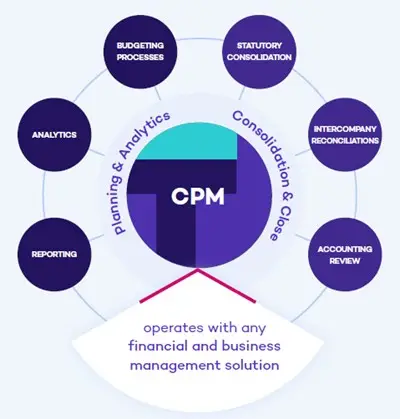
Planning & Analytics: from information to decision-making
The first aspect of the platform focuses on the ability to continuously Plan and Analyse performance. Reporting plays a central role here, enabling the automatic generation of financial and management reports that are always up to date and consistent. This automation reduces the time spent preparing information and ensures that decision-makers work with reliable data.
The analytical component adds depth to the understanding of the business. Through multidimensional analyses and dynamic dashboards, it becomes possible to explore performance from different perspectives — activity, business unit or scenario — facilitating the identification of trends and deviations.
Budgeting and forecasting processes are structured collaboratively, involving different areas of the organisation. This approach allows operational knowledge to be incorporated into planning, increasing the accuracy of forecasts and reducing reliance on long, rigid cycles. The result is more agile planning, better aligned with reality and capable of continuously evolving.
Consolidation & Close: consistency, control and confidence
The second aspect of the platform focuses on consolidation and financial close processes, which are essential for ensuring the reliability of information.
Statutory consolidation is automated, ensuring compliance with local and international standards, such as IFRS. Data is processed in a structured manner, with full traceability and control over the adjustments made.
Intercompany reconciliations, which are often complex and time-consuming, are now managed collaboratively, with alert and validation mechanisms that enable discrepancies to be identified and resolved more quickly.
Intercompany reconciliations are now managed collaboratively
In addition, the accounting review process is supported by automated controls and digital documentation, facilitating interaction with auditors and enhancing transparency.
This integration enables faster financial close, reduces the risk of error and ensures confidence in the data underpinning decision-making.
The pillars that make the difference
In a volatile environment, financial planning only creates value when it is based on solid, well-defined foundations.
In the case of solutions such as Talentia CPM, these three pillars are reflected in the way the platform structures and integrates key financial processes:
- The ability to plan and analyse on an ongoing basis. The integration of reporting, analytics and budgeting processes enables planning to keep pace with the reality of the business, incorporating up-to-date data and input from different departments. The result is a more dynamic view, less dependent on rigid cycles and more focused on adaptability.
- Data consistency and reliability, ensured by consolidation and closing processes. The automation of statutory consolidation, inter-company reconciliations and accounting controls ensures that the information used is accurate, traceable and aligned with compliance requirements.
- Integration between processes, which enables traditionally isolated activities to be transformed into a continuous management flow. When planning, consolidation, reporting and analysis operate within the same environment, information flows seamlessly and decision-making becomes faster and more informed.
It is this combination – agile planning, reliable data and integrated processes – that enables financial planning to be transformed into a decision-making tool, even in highly uncertain environments.
Preparing the present to meet the future
Volatility cannot be eliminated, but it can be managed more effectively. Organisations that adopt an integrated approach to performance management are able to respond more quickly to change, with greater control and confidence.
In the current climate, planning is no longer enough. The ability to analyse, integrate and make timely decisions is what makes the difference.
At Izertis, we help implement solutions such as Talentia CPM and Infor EPM, transforming financial planning into a true driver of decision-making. Contact us to find out how to make your decisions faster and more confident.