

Faster financial close: myth or competitive advantage?

For a long time, the financial close has been viewed as an inevitably slow process — several teams involved, multiple files, cross-checking, and last-minute adjustments. A heavy mechanism that demanded effort but rarely added real value.
Today, the question is no longer whether the close can be faster, but rather what prevents it — and how that limitation affects the organisation’s competitiveness.
Slow closes are a symptom, not the cause
In most organisations, delays in the financial close stem from how processes are structured — with data spread across different systems, manual validations, and adjustments that are difficult to track.
The real problem is not time, but fragmented models
Time is not only lost producing figures, but also reconciling, validating, and redoing unnecessary tasks.
When the model is fragmented, the close inevitably becomes slower and more error-prone. This is where technology stops being a mere support tool and becomes structural.
Automate to reduce errors, build trust, and free up time
A large part of the effort in closing is spent reconciling discrepancies and reviewing versions that complicate the process. By centralising information and automating workflows, organisations can drastically reduce the risk of human error, achieve full traceability of changes, eliminate redundant work, and strengthen management’s confidence in the results.
Moreover, a faster close does not compromise quality — in fact, the more automated it becomes, the more robust and transparent it gets.
Platforms such as Infor EPM integrate consolidation, reporting, and planning into a single environment, allowing the close process to be structured around defined rules and controlled flows. This reduces friction and dependencies. Thus, time is not artificially shortened, but reduced because the process becomes smoother and more predictable.
Planning and closing: two sides of the same process
Another common limitation is the disconnect between closing and planning. When actual data does not automatically feed into forecasting and simulation scenarios, consistency and agility are lost.
Closing becomes the starting point for more informed decisions
Integrating consolidation and planning within the same ecosystem allows forecasts to be powered by consolidated actuals, enabling faster scenario simulation and keeping strategy and execution aligned.
As a result, the close ceases to be the end of a cycle and becomes the starting point for more informed decision-making.
Productivity, usability and ROI: the new decision criteria
Choosing a CPM solution is not just about technical features. Its impact is measured in three key dimensions:
- Productivity: Effective reduction in closing time and manual tasks.
- Usability: Ability for the team to work without excessive dependence on IT.
- ROI: Tangible gains in reducing errors, rework, and compliance risks.
When these three factors are aligned, the financial close stops being a repetitive effort and becomes a predictable, controlled, and strategic process.
Measurable results and competitive advantage
The adoption of specialised CPM solutions also yields concrete benefits. According to Nucleus Research, organisations that have implemented Infor EPM have achieved a 20% improvement in financial process productivity, significantly faster consolidation models, and a reduction in costs associated with legacy infrastructures.
Infor EPM enables a 20% increase in productivity
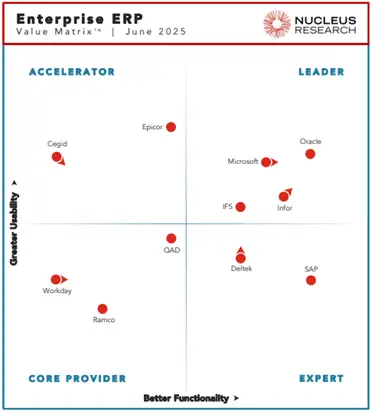
Furthermore, Infor has been recognised as one of the leaders in Nucleus Research’s "Enterprise ERP Technology Value Matrix 2025".
A distinction that reinforces the strength and maturity of its technology ecosystem — a key factor in enabling faster, more controlled, and strategically aligned financial closes.
From time saved to competitive advantage
Closing two or three days earlier may seem like just an operational improvement, but in reality, it represents much more — a strategic advantage. It means gaining earlier access to reliable information, detecting deviations faster, and adjusting forecasts before the market forces the change.
In a volatile context, speed of reaction is crucial. The finance department is no longer seen merely as an information centre but takes on an active role in guiding the business.
So, myth or competitive advantage?
Faster financial closes are not a myth, but the result of well-designed processes supported by the right technology. The competitive advantage does not lie only in closing two days earlier, but in gaining greater confidence in the figures, accelerating decision-making, and freeing the finance team to focus on what truly creates value.
In a context of increasing demands and ever-shorter economic cycles, a finance function that masters its processes stops chasing numbers and starts anticipating the future. And that is no longer just operational efficiency – it is strategic leadership.
At Izertis, we help optimise financial closing with CPM solutions such as Infor EPM and Talentia. Contact us.