
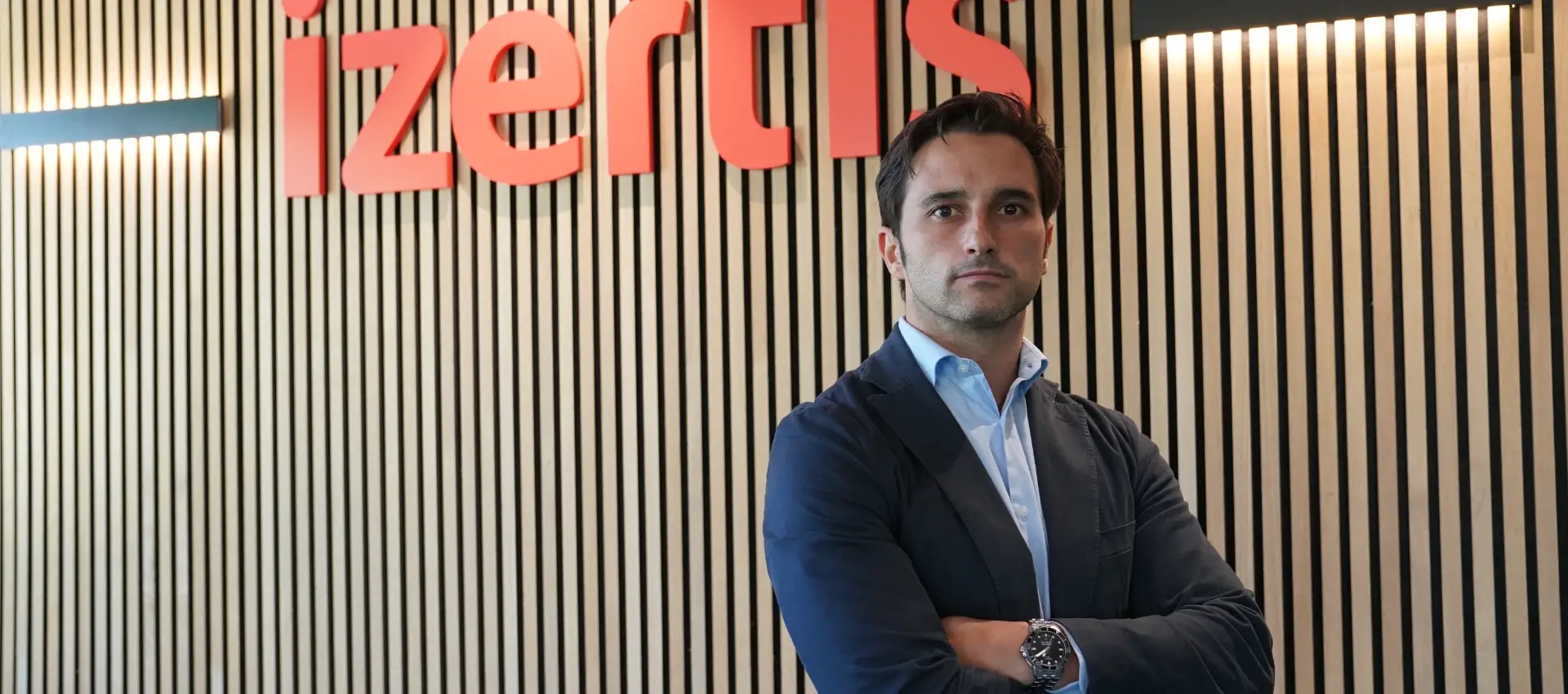
Ignacio Bobes: “The challenge is no longer implementing AI, but integrating it effectively and measuring its value in a regulated environment”
The pharmaceutical industry is accelerating its digital transformation, driven by structural decisions: migration to next-generation CRMs, the adoption of AI, and increasing compliance requirements. The focus is shifting towards the integration of processes and data to improve efficiency and business consistency.
Izertis is consolidating its position in this sector with specialist teams and projects focused on implementation in regulated environments.
We spoke to Ignacio Bobes, head of the Pharma Business Unit at Izertis, about the current trends in the sector and the company’s positioning.
1- What is currently driving digital transformation in the pharmaceutical sector, and what trends will shape technological decisions in the sector in the short and medium term?
There are currently three major trends driving digital transformation in the pharmaceutical sector. The first, without a doubt, is the emergence of generative AI and agents. From individual use by people to optimise their daily tasks, to solutions that help streamline and improve existing processes, such as training for representatives or for the automation of regulated document processes.
The second relates to the changes currently taking place in systems as critical as CRM. Many companies are completely overhauling their technology stack, migrating to new platforms or reviewing how they manage their relationship with healthcare professionals. This is forcing us to rethink processes that have been running in the same way for many years.
And the third, which is perhaps the most transformative in the long term, is the impact of AI on pharmaceutical drug discovery. We are seeing how artificial intelligence is beginning to speed up processes that traditionally took years.
AI is beginning to speed up processes that previously took years
The difference compared to a few years ago is that back then we talked a lot about digitalisation with a focus on AI, but without a clear idea of where to apply it.
The challenge has now shifted: there are already plenty of use cases on the table, and the real challenge now lies in prioritising the AI roadmap effectively so as not to end up floundering in the dark.
2- If a pharmaceutical company had to prioritise just two areas in 2026, which ones would they be and what impact would they hope to achieve?
Given the way the pharmaceutical industry operates – it is highly regulated and quite methodical in its decision-making – I believe that 2026 will be more a year of streamlining and consolidation than of experimentation. A report by MIT last year indicated that 95% of AI pilots failed, and that is something the industry cannot afford.
2026 will be more a year of streamlining and consolidation than of experimentation
Everything to do with regulation and governance of technology is going to carry a lot of weight. Regulations such as NIS2 and ISO 42001 are beginning to shape the framework within which many digital solutions will be developed, particularly those involving AI.
And another major challenge we’re seeing in almost every company is that of prioritising that AI roadmap effectively.
This will prevent projects from operating in isolation across different departments within a company and give them a clear purpose, as well as making it easier to measure the ROI of those projects.
Ultimately, the most successful companies will be those that manage to make AI truly operational, rather than just isolated initiatives.
Ignacio Bobes, head of the Pharma BU
3- Why has the move to next-generation CRMs become a turning point for many pharmaceutical companies?
Firstly, because in many cases companies are practically forced to migrate their current systems to new platforms. And that means the decision is no longer purely a technical one. When a pharmaceutical company switches its CRM system, it is actually taking the opportunity to rethink many of its internal processes.
Strategic questions are beginning to arise: How do we want to engage with doctors and pharmacies in the coming years? What role does omnichannel really play? How does artificial intelligence fit into the business model of the future? Or even whether the AI capabilities offered by CRM providers themselves are sufficient for the rest of the company.
4- What does it mean to ‘truly integrate’ the digital ecosystem (CRM, data, analytics, content and channels), and where do these programmes typically fall short?
In my view, it involves putting all the pieces of the puzzle together so that we can make better decisions and streamline our processes. The biggest problem we face is that the tools are integrated, but not the processes.
How often have we heard comments such as “the data from BI and CRM do not match”, “I have duplicate accounts in CRM because of the integration with the ERP” or similar remarks? The key to successful integration is to start with the data model and then move on to the technology, rather than the other way round.
Izertis' positioning
5- What kind of challenges does Izertis typically tackle in the pharmaceutical sector: rapid innovation pilots, industrial scaling, or the recovery and optimisation of complex ecosystems?
We usually get involved in projects that require a high level of sector specialisation. Complex challenges, closely tied to the business, where people are needed who truly understand how the pharma industry works.
We tend to operate in three types of situations: when something new needs to be built with purpose, when initiatives that have already proven their value need to be scaled, or when order needs to be brought to ecosystems that have become overly complex.
Our major differentiator is that we do not start from scratch. We come in with industry, process, and technology knowledge, which enables projects to move much faster, with less friction and, above all, with a much stronger focus on generating real impact from the outset.
6- What capabilities, solutions or technologies do you think set Izertis apart in the pharmaceutical sector, particularly in terms of the integration of CRM, AI, data and compliance?
We do not work in silos, and that is what mainly distinguishes us. In Pharma, everything is interconnected: CRM, data, AI, and compliance, and we approach it in an integrated way from the very beginning.
At Izertis we have a specialised Pharma team
We have a specialised Pharma team that operates across the entire company and becomes involved in projects from the start to ensure that what is designed makes sense both from a business and regulatory perspective.
CRM is where this is most evident. We have more than 120 specialised professionals, a significant portion of whom are dedicated exclusively to Pharma.
This allows us not only to implement technology but also to connect CRM with AI models, data quality, and compliance requirements, which is ultimately where real value is created in the industry.
7- In which processes or areas does Izertis currently add the most value within the pharmaceutical sector?
Although our expertise in the industry stems from CRM – and this is where the majority of our specialised resources are concentrated – in recent years we have made significant inroads into areas such as PMO and consultancy thanks to the cross-functional teams we have brought on board. Over the past two years, the company has taken on new clients for this type of service.
When it comes to AI, we have developed projects that deliver real value to the industry, such as REP+ (a pre- and post-visit chatbot) and Cizero (training and onboarding for sales representatives), both of which provide significant support to sales excellence teams in managing their sales networks.