
Productivity and market growth: Microsoft and Izertis link AI deployment to security and data
To talk about Artificial Intelligence is to think ahead about ‘what will happen’, whilst focusing on ‘what we do today’. What is the current consensus among tech giants and consultancy firms regarding the real impact of AI on business? What steps should be taken to implement AI without losing control? What role should data security and governance play before scaling up use cases?
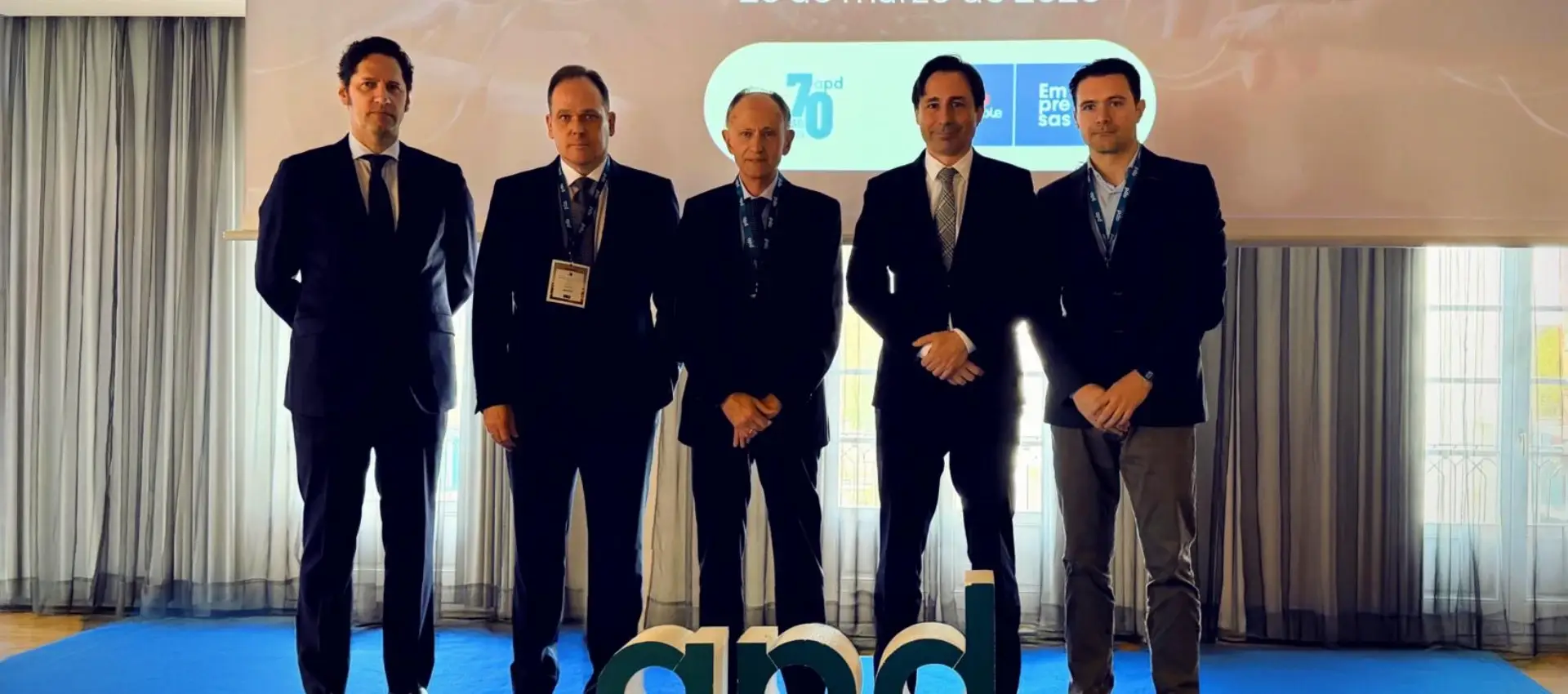
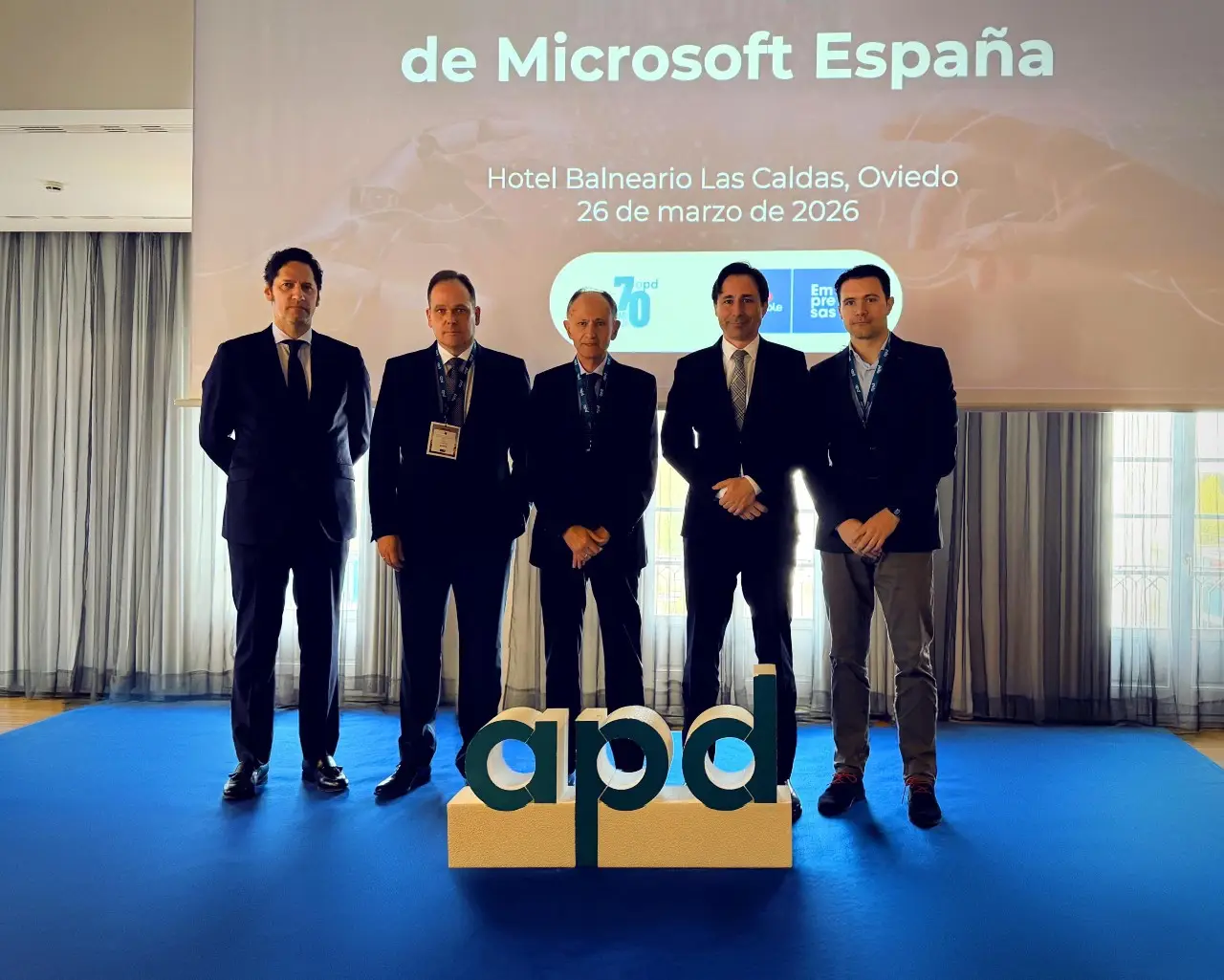
The discussion in Oviedo between Paco Salcedo, President of Microsoft Spain, and Pablo Martín, President and CEO of Izertis, centred on AI—both its present and future—and the two agreed on a key point: AI does not shrink the sector, but rather expands the market for IT services by boosting productivity and making viable projects that are currently not being implemented due to a lack of budget, time or staff.
AI does not shrink the sector, but rather expands the market for IT services by boosting productivity and making viable projects
The event, organised by APD Asturias and sponsored by Telecable, focused on the area of greatest concern to organisations: how to adopt AI in a way that has a real impact on business without compromising data control or security.
Before the discussion between Salcedo and Martín, Javier Sáenz de Jubera, president of APD Asturias, and Juan Acuña, director of Telecable in Asturias, took the floor.
The discussion was moderated by Enrique Méndez, TechLead for Business Apps at MasOrange.
Greater productivity, more projects, a larger market
Far from taking an alarmist stance, the conversation between the president of Microsoft Spain and the president and CEO of Izertis centred on a shared assessment: AI is advancing at breakneck speed, but its effective implementation depends less on ‘having the technology’ and more on transforming the way we work.
During his speech, Paco Salcedo described a scenario of continuous innovation, with a shorter timeframe between the launch of new capabilities and their actual impact on the business. In this regard, he highlighted a point that crops up time and again in any presentation: “unlearning”. The adoption of AI involves adapting processes, roles and habits, even within large companies. “I think it’s really important to experiment,” he said, adding that it’s also important to learn quickly and do so in a controlled manner.
The adoption of AI involves adapting processes, roles and habits, even within large companies
Pablo Martín added a key caveat for management teams: although the change will be far-reaching, adoption is usually more gradual than some predictions suggest, due to regulatory and infrastructure barriers and, above all, the cultural dimension of reskilling.
“We tend to overestimate the short-term impact of technological changes and underestimate the long-term impact”, he said. “We still have time to get the job done.”
IT services sector
The IT services sector became one of the main topics of discussion. He did so when the president of Izertis directly addressed one of the most frequently repeated narratives of recent times: that AI will reduce the demand for professional services and render some tech-related work redundant. His response was unequivocal: he does not expect a net loss of jobs; on the contrary, he anticipates more jobs and greater productivity, with positive outcomes for both businesses and society.
The argument is both practical and cost-effective. There are projects that aren’t being carried out today because of a lack of resources: budget, time or the availability of suitable candidates. If AI reduces the effort required (in terms of staff, hours and cost), many initiatives go from being “impossible” to “feasible”.
Hence his most direct conclusion for the market: “I believe that the market for professional services in general is set to grow”, including IT services, precisely because productivity is expanding the scope of what organisations dare to do and are able to tackle. “Some companies are starting to do things that, until now, they hadn’t considered because of their size or their resources”.
At this point, he highlighted the pessimistic forecast for the IT services sector and countered it with figures on job creation for programmers in the US in the first quarter of the year: “They’re still growing. ‘Although it is obviously true that it is becoming easier and easier to programme using AI, and that this is more productive, it is not destroying jobs; it is transforming them."
If AI reduces the effort required, many initiatives go from being “impossible” to “feasible"
The president of Microsoft Spain, Paco Salcedo, reinforced this argument by drawing a parallel with other transformations we have already seen: the shift to e-commerce did not eliminate jobs; it restructured the workforce and created new specialisations.
In his view, the impact favours those who adapt and capitalise on new demands, and he dismissed all “doomsday scenarios” regarding AI.
“Mathematical theory is what it is, and this is mathematics—on a massive scale and of enormous magnitude—but it is still mathematics. Like all technology, it has its pros and cons and comes with risks, but we are the ones who are going to build it. I share this positive view.”
Scaling up data security and governance
Another point on which there was complete agreement was that without security, there will be no sustainable adoption of AI. At this point, Paco Salcedo described cybersecurity as an “existential” issue and recommended tackling it in an “integrated” manner (devices, data and identity), avoiding fragmented solutions and opting for platform-based approaches.
He also advocated the use of AI in defence, “assuming that you will be attacked” and building resilience and recovery capabilities into the design. “We invest 4 billion a year in cybersecurity; we are the most targeted organisation in the world after the US government; we have learnt from being attacked”.
Pablo Martín highlighted a practical issue that is already evident in organisations of all sizes: that AI implementations lacking holistic governance can create serious internal rifts, particularly when uncontrolled agents, automation processes or data access proliferate. His conclusion was unequivocal: “The most important thing of all is to deploy secure technology”.
Both also emphasised the importance of using corporate platforms to preserve value and protect sensitive data, thereby preventing haphazard experimentation from exposing critical information.
Talent and judgement
The talk, delivered to an audience of around a hundred people from the business and financial sectors, also highlighted an important point regarding change management: the human role is reinforced in the oversight, coordination and governance of AI. The president of Izertis framed it as a matter of proper use, where the problem is not the tool itself, but rather understanding what it offers and what the professional must do to obtain reliable results.
Salcedo described the mix of generations as a “winning formula” (combining experience with new skills). “AI allows us to preserve knowledge,” he said, and pointed out a useful limit to avoid falling into a rut: “AI thrives on the past. AI isn't going to shape the future. The models are trained on past data, but they won’t tell us how to improve things in the future. "That's up to us." And it is crucial, he added, to avoid "cognitive surrender".
Future
The conclusion of the discussion, which also touched on European technology regulation (“when implemented effectively, it is considered a valuable asset”) and the level of technological maturity in Asturias (“comparable to that of other Spanish regions”), looked ahead to what lies in store.
According to Paco Salcedo, “future technological advances will include the combination of AI with quantum computing, new mass storage technologies and more sustainable data centres.” Meanwhile, Pablo Martín emphasised the positive message regarding AI: it will boost productivity and transform the world of work, creating more high-value jobs and delivering a positive return for society.