
Izertis completes FoodCarbon, the platform that digitizes and verifies emissions from the meat industry

A few months ago, we presented FoodCarbon as an example of how the application of emerging technologies can help address one of the food industry's major challenges: the decarbonization of its production processes. The starting point was clear: to digitize the carbon footprint and transform it into a quantifiable, traceable and unalterable indicator, supported by real process data, energy consuption monitoring, renewable energy integration, tokenization and blockchain.
Today, the FoodCarbon project comes to an end after going through its first full cycle of innovation and after completing the journey from conceptual definition to validation of a functional protype in a real industrial environment. The result is a solution capable of measuring, recording and offsetting emissions in a transparent and auditable way, in line with the current needs of the sector.
A real case at ASINCAR's pilot plant
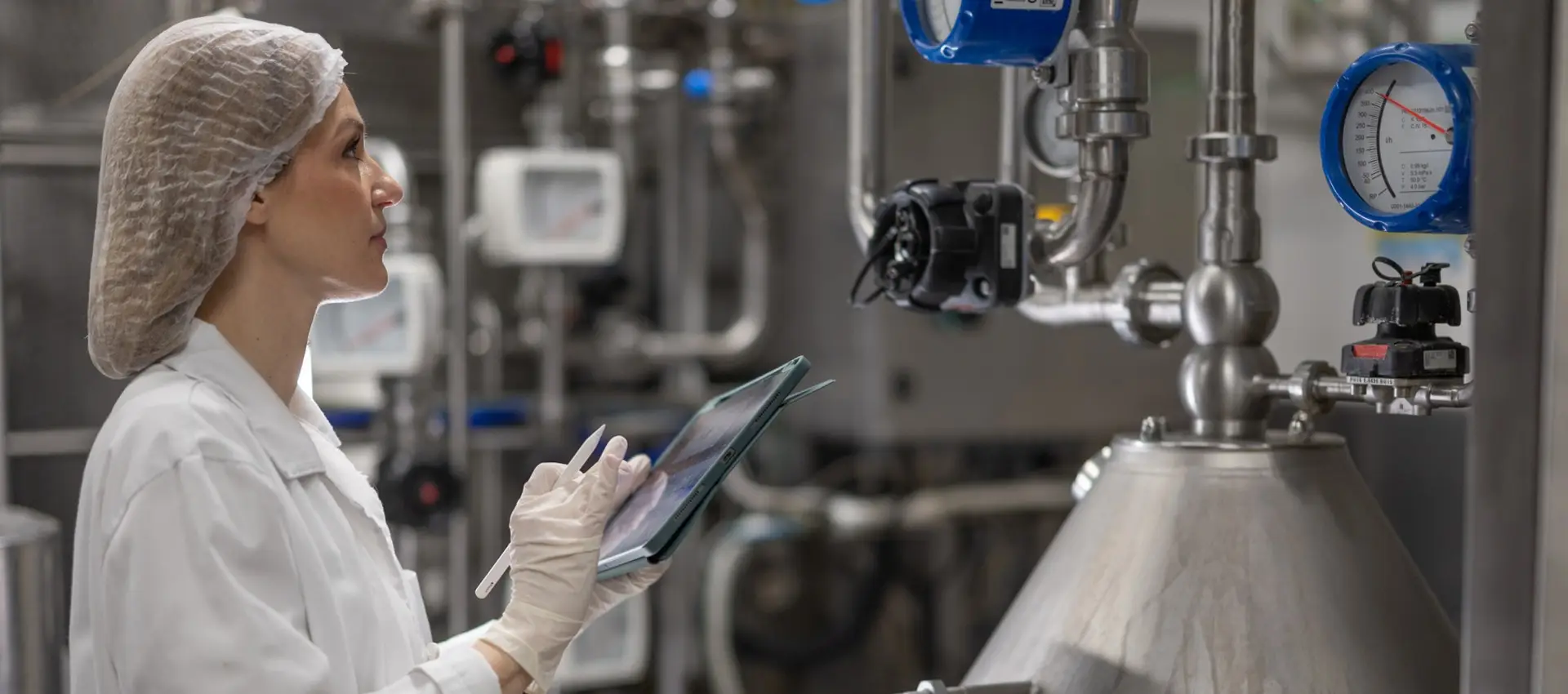
To develop this project, Izertis collaborated with the Asturian technology centre ASINCAR, which facilitated access to data from its pilot plants as an environment for data collection and validation. The selected use case has been the production of chorizo, a particularly interesting process due to the diversity of steps it integrates and the variety of associated energy consumption.
FoodCarbon was able to model the complete production process
In its initial stages, FoodCarbon was able to model the complete production process, taking the product batch as a unit for analysis.
Based on this, the tokenization of emissions and their traceability was structured, which allowed energy consumption to be divided into stages and the carbon footprint to be calculated in a disaggregated way.
This approach offers a much more accurate view of the environmental impact of the process, identifying which phases concentrate the most emissions and where there is greater room for improvement, always based on real operational data.
From concept to functional prototype
FoodCarbon exemplifies a complete cycle of R+D+i: from the initial idea to the construction of a prototype capable of integrating multiple technological layers into a single solution. Thus, based on the data generated by a sensorized plant, the developed application makes it possible to structure the information of each batch, associating it with its different stages of manufacture and transforming this set into a solid basis for calculating the carbon footprint. All this under criteria of verifiability, traceability and immutability.
TIn this way, the generated prototype is not limited to providing a final estimate of emissions, but also organizes and relates the information that explains how this impact is generated throughout the production process. This approach allows us to work with a much more detailed and useful view, which provides granularity to the information available about the process, fundamental for subsequent decision-making.
Emissions calculation and verifiable traceability
The core of the solution is the carbon footprint calculation model, which focuses on electricity consumption per batch and per stage. Based on this data, the system applies equivalence factors that translate energy consumption into CO2 emissions. This calculation is not considered as an isolated result, but as part of a verifiable traceability system.
The core of the solution is the carbon footprint calculation model
Through the use of blockchain technology, an immutable layer of evidence is incorporated, where hashes, relevant events and operations linked to the certification and possible offsetting of emissions are recorded, through the introduction of renewable energies in the process.
Thanks to this approach, it is possible to prove what information was used, how it was processed and what results were obtained. The information is permanently recorded, which guarantees its auditability and reinforces confidence in the system.
Data analysis, tokenization, and emissions offsetting
In this calculation model, an emissions analysis, tokenization and offsetting system is built that allows working with the data in an operational approach: based on consolidated production and consumption information, it is possible to identify critical steps in the process, establish impact ratings and identify precisely where measures should be taken to reduce both energy consumption and associated emissions.
At the same time, process data is translated into CO₂ equivalent emissions and represented as digital tokens, making it easier to manage and monitor. In addition, this same system incorporates the ability to offset emissions through absorption tokens, generated by the use of renewable energies that avoid emissions.
Tokenization is a structural element of the solution developed by FoodCarbon
In this way, tokenization is no longer just a traceability mechanism, but a structural element of the solution, allowing both the generation and the offset of emissions to be represented in a way that is consisent with the calculation of the carbon footprint, and to do so digitally, verifiable and traceable end-to-end.
A conclusion with a vocation for continuity
For Izertis, FoodCarbon represents a significant step forward in consolidating capabilities in blockchain, industrial traceability, tokenization, and data analysis applied to sustainability.
In a context where sustainability, transparenct and competitiveness are increasingly united, projects like this one chart a clear path: that of a more efficient, more reliable and better prepared meat industry for the challenges of the future.