
AI for business: from technological promise to real impact
Artificial intelligence is no longer a promise for the future; it is a reality that is redefining the way we work, make decisions and generate value. At Izertis, we see it as a lever for transformation with real impact, not as a one-size-fits-all solution.
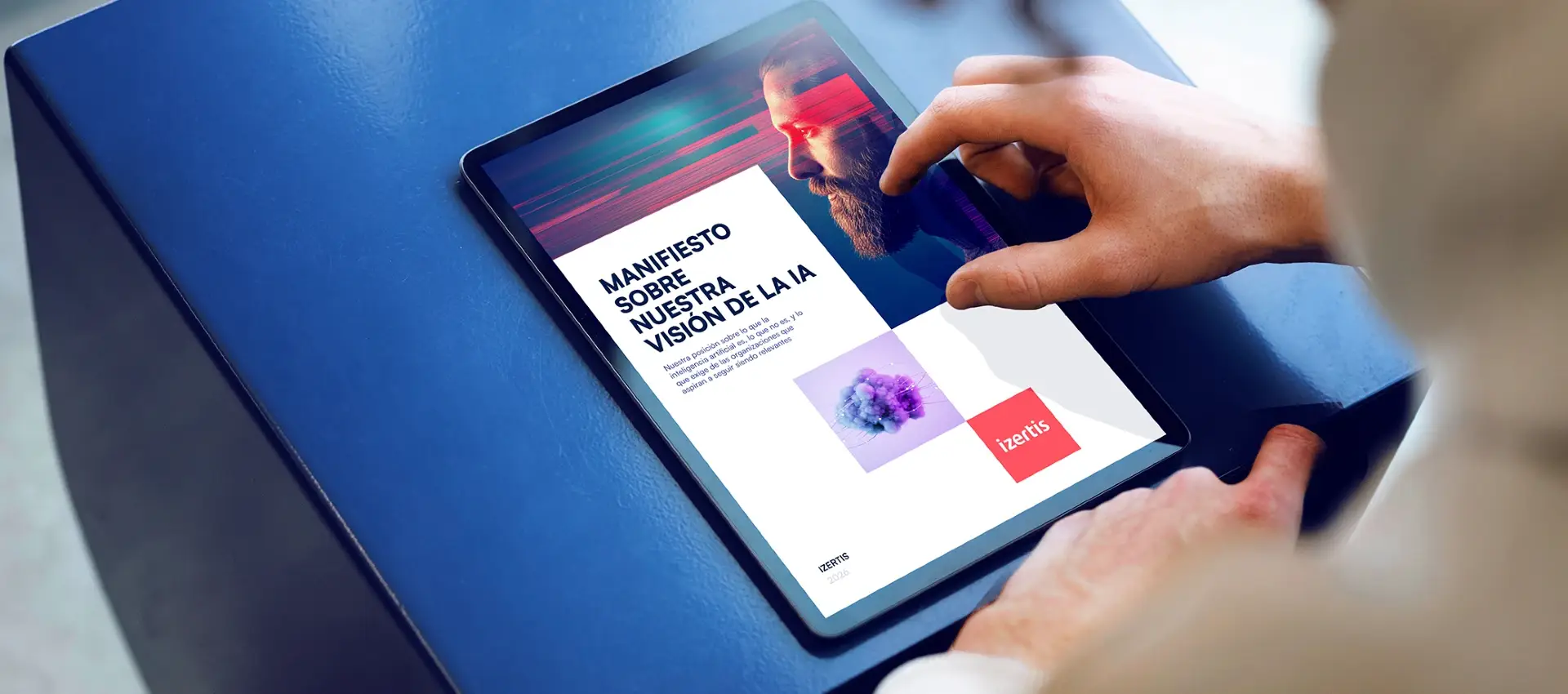
In this context, we have set out our vision of AI in a manifesto: a practical, realistic perspective grounded in our experience with clients. It is based on the idea that AI creates value when it is applied with judgement, when it addresses a specific need, and when it is supported by the organisational capabilities required to sustain its adoption.
AI is already part of everything we do
Artificial intelligence is not a technological bubble or a passing trend. It is already transforming how organisations operate, make decisions and design their services. Its impact goes far beyond productivity: it affects business models, internal processes and the way competitive advantage is built.
AI delivers greater value when it is integrated with judgement
Our manifesto starts from this reality: a technology that is already part of the present and that compels us to rethink how we work, operate and create value.
However, the existence of the technology does not mean its adoption will be immediate or uniform. Experience shows that major transformations require time, maturity and context.
In the case of AI, four key factors also come into play: regulation, risk management, available infrastructure, and the true capacity of people and organisations to transform.
Its adoption will be gradual
The speed at which AI evolves does not always match the pace at which organisations can absorb it. In highly sensitive sectors, where the margin for error is minimal and regulatory requirements are stricter, adoption will necessarily be more cautious.
From our perspective, this more gradual implementation should not be seen as a weakness. On the contrary, it enables more robust deployments, with stronger guarantees and better alignment with each organisation’s reality. AI delivers far greater value when it is integrated sustainably than when it is introduced hastily.
The real change is organisational
One of the main challenges of AI lies not in the technology itself, but in people and how they work with it. Successful adoption requires revisiting processes, strengthening capabilities, and properly supporting the cultural change that comes with incorporating new tools into day-to-day work.
As our manifesto states, transformation does not happen simply by having a solution, but by creating the conditions for that solution to fit within the organisation. This process also impacts how services are delivered, how roles evolve, and the value of expert knowledge.
One of the biggest challenges of AI lies in people and how they work with it
AI does not eliminate this value; it reshapes and amplifies it. In this sense, professional services are not facing disappearance, but evolution.
The way services are delivered will certainly change, new needs will emerge and some roles will be reorganised. However, human judgement will remain decisive.
In this context, the advantage will not lie in having access to the technology, but in integrating it better than others.
In the coming years, AI will tend to become commoditised, meaning the difference will lie in execution quality, adaptability and the ability to turn technology into real results.
AI with governance and judgement
For AI to deliver value sustainably, it must be accompanied by data governance, cybersecurity and human oversight. These are not optional extras, but fundamental conditions for responsible adoption.
Data quality, access control, traceability and the ability to supervise outcomes are factors that can no longer be overlooked. When AI is fuelled by poorly governed data, it amplifies the problem; when it is integrated rigorously, it multiplies impact. This is the difference between experimenting with technology and building real business capability.
Realistic optimism
Our vision of AI is optimistic, but not naive. We believe it is one of the greatest drivers of productivity and transformation of our time, although its deployment will be progressive, uneven and conditioned by each organisation’s level of maturity.
AI is the greatest lever for transformation in history
For this reason, the differentiator will not be who adopts the technology first, but who develops the capabilities, culture and operating model needed to make the most of it.
At Izertis, we are convinced that this is where real competitive advantage is built.
Our perspective
Artificial intelligence is neither a threat nor a magic solution. It is a lever for transformation that, when properly integrated, can unlock new opportunities, accelerate capabilities and strengthen how organisations create value.
At Izertis, we believe its true potential lies not only in what it does today, but in what it will enable in the medium and long term. That is why we advocate for AI at the service of the business, expert knowledge and tangible value creation: an AI that enhances judgement, amplifies experience and becomes a structural part of organisational evolution.
This is the approach with which we aim to continue supporting our clients: with realism, ambition and the conviction that the difference will not be made by those who adopt AI first, but by those who integrate it better, in a more robust, useful and sustainable way.
True transformation is not about adding more technology, but about turning it into impact